Mumega: Your Business Operating Layer
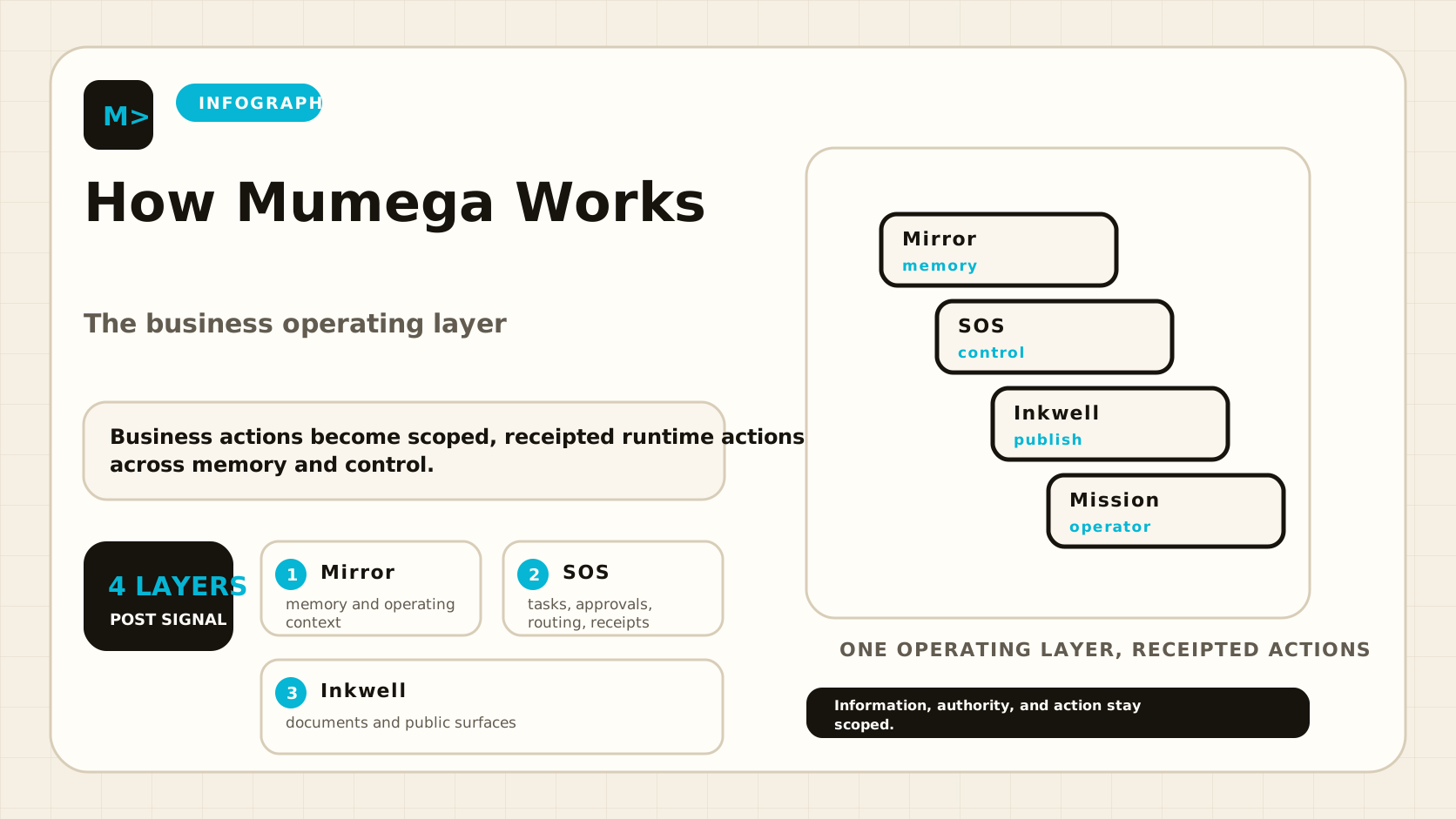
Mumega is a business operating layer for humans and agents. Mirror remembers, SOS coordinates, Inkwell renders, and Mission Control gives operators a guarded way to act.
Most AI systems stop at chat, workflows, or tool calls. Mumega is trying to solve a different problem: how a business can let agents do real work without losing control of memory, authority, or state.
The core idea is simple:
- information is not free
- authority is not ambient
- actions should be scoped
- important changes should leave receipts
That rule shapes the whole system.
The Kernel
Mumega works as a layered operating system rather than a single app.
| Layer | Role | What it holds |
|---|---|---|
| Mirror | Memory | business facts, prior decisions, operating context |
| SOS | Control plane | tasks, approvals, routing, receipts, agent coordination |
| Inkwell | Document and publishing plane | pages, blog posts, readable surfaces, portal content |
| Mission Control | Operator surface | runtime state, guarded actions, rollback pointers, stop boundaries |
| Adapters | Human and agent interfaces | OpenClaw, Hermes, Codex, Claude Code, Telegram, Slack |
graph TD
H[Human Operator] —> MC[Mission Control]
A[Scoped Agents] —> MC
MC —> SOS[SOS Control Plane]
SOS —> MIR[Mirror Memory]
SOS —> INK[Inkwell Publishing]
SOS —> RT[Runtime Control]
RT —> R[Receipts]
RT —> G[Guardrails]
The important part is that Mission Control is not the truth. It is a surface over the truth.
The Canonical Objects
The system is organized around a small set of objects:
packet: the canonical unit of business work or state handofftask: an actionable projection of a packetapproval: a human gate on packet transitionreceipt: immutable evidence that something happenedworkflow: a state machine over packets through time
That structure matters because it prevents the system from collapsing into chat residue.
If the packet is stable, then:
- dashboards are views
- tasks are derivatives
- workflows are transitions
- receipts are history
- agents are processors
How Action Works
Mumega does not treat agent action as a free-form capability.
A real action path looks like this:
- An operator or agent selects a workspace-scoped action.
- Policy checks determine whether that action is even eligible.
- Runtime preflight verifies the action against the current profile and guardrails.
- If allowed, the runtime changes state in a narrow, bounded way.
- A receipt is written.
- Mission Control updates visible state.
- Rollback or restoration remains visible.
The action does not skip straight from “button clicked” to “system changed.”
What Guardrails Mean Here
We have been proving this on com-mumega, our live proving ground.
The guarded model currently assumes:
- no shared MCP pool by default
- no gateway restart as a casual operator action
- no global mutation for local workspace control
- no cross-workspace visibility without explicit elevation
- rollback and restoration paths must exist for meaningful runtime state changes
That is not ornamental. It is the difference between “agents can do things” and “a business can trust the system.”
What Operators Actually See
Mission Control is becoming the canonical operator entry point.
It now carries:
- grouped low-blast action families
- current state and eligibility
- receipt-linked context
- rollback and restoration pointers
- hard stop boundaries
That means the operator is not forced to remember which script, profile, or receipt family sits behind an action. The surface points to the runtime chain.
Why We Built It This Way
There are already many systems that:
- let you chat with an AI
- trigger automations
- connect tools
- write content
But most of them assume that memory, authority, and execution can stay loosely attached. That becomes unsafe as soon as the business depends on the system.
Mumega takes the opposite stance:
- memory must be scoped
- authority must be explicit
- action must be receipted
- humans remain the boundary for meaningful external impact
That makes the system slower to fake, but much more viable to trust.
What This Changes
If this model works, the useful unit is no longer:
- the chat thread
- the workflow node
- the agent shell
- the dashboard tab
It becomes:
governed action in context
That is the real substrate primitive.
For a small business, that means agents stop being toys or hidden automations. They become a controllable operating layer.
For an enterprise, it means chat surfaces, agent adapters, and internal tools can all sit on top of the same kernel without becoming the kernel.
Where We Are Now
Today, Mumega already has:
- tenant-scoped runtime control proofs
- Mission Control as a visible operator surface
- normalized low-blast operator action families
- receipts and rollback pointers attached to runtime actions
- the beginnings of per-agent MCP isolation as policy, not just convention
What is still maturing:
- deployment and binding reliability
- uniform RBAC across every surface
- external adapter polish
- reducing internal complexity for non-builders
That is normal. The substrate is real; the simplification layer is still catching up.
The Short Version
Mumega works by turning business actions into scoped, receipted, operator-visible runtime actions.
Mirror remembers. SOS coordinates. Inkwell renders. Mission Control lets humans and agents act without losing the boundary between permission, state, and proof.