Anthropic Shipped Managed Agents. The Multi-Tenant Orchestration Layer Above Is Still the Layer Above.
On May 6, 2026, Anthropic announced Claude Managed Agents at its Code with Claude developer event in San Francisco. The launch added four capabilities to the Managed Agents API: multiagent orchestration (a lead agent dispatches specialists with their own models and tools), an outcomes-loop rubric evaluator (a separate Claude instance grades agent output against a rubric and triggers retry until the rubric passes), dreaming (a scheduled background process that reviews past agent sessions and curates memory between runs), and webhooks (asynchronous completion notification for long-running work).
The launch is significant. It validates the agent platform category. It ships primitives — particularly outcomes loop and dreaming — that previously existed only inside research teams’ internal tooling. It demonstrates that foundation providers are willing to invest substantial engineering in the platform layer, not just the model layer.
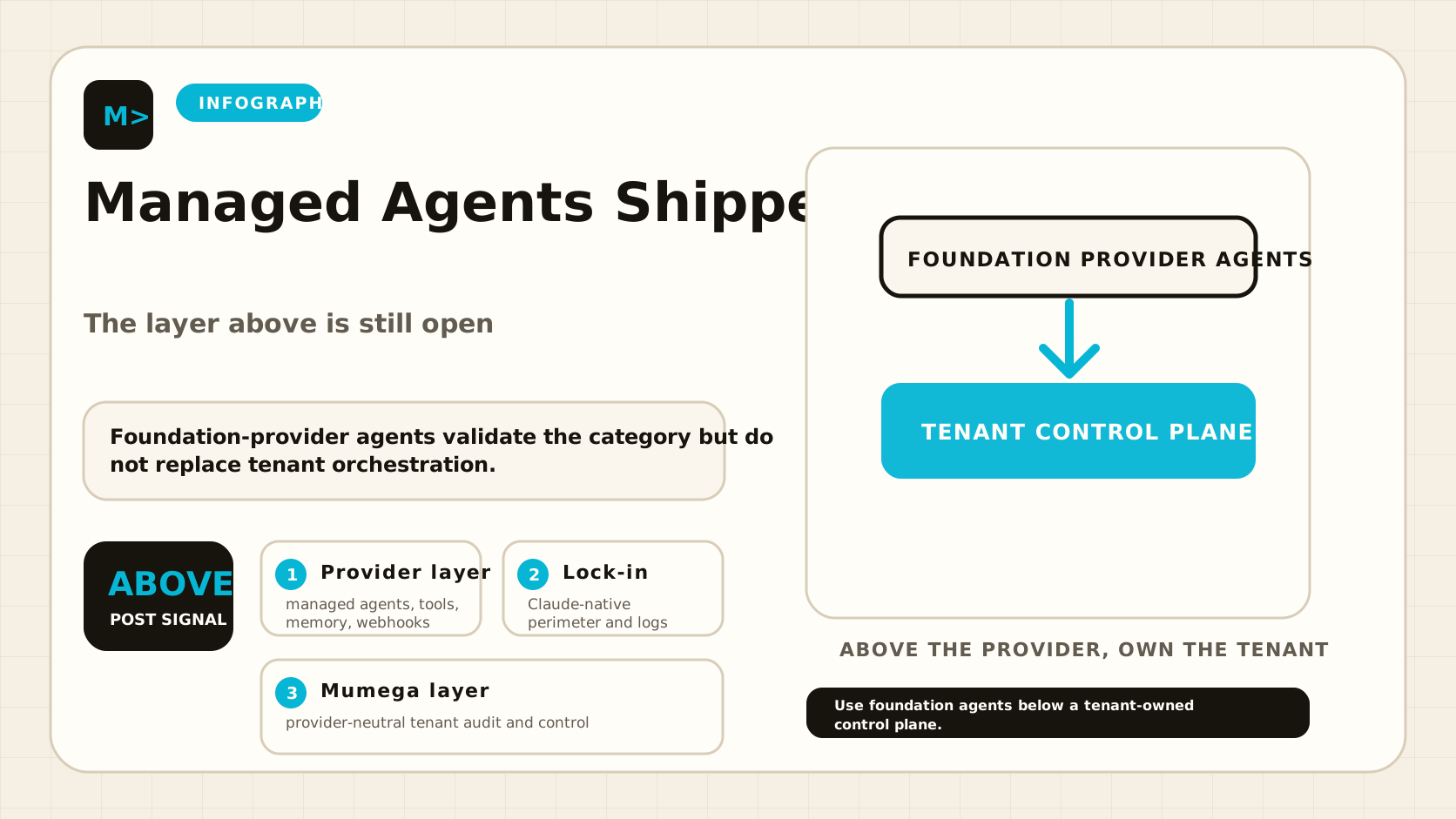
The launch does not occupy the slot Mumega has been building for. We documented the foundation-provider competitive layer in Conway, Codex, and the Layer No Foundation Provider Can Build two days before Managed Agents shipped. The argument there was that foundation providers, by their lock-in business model, structurally cannot ship the orchestration substrate that composes multiple foundation providers under one customer’s deployment. Anthropic’s launch yesterday is consistent with that argument: Managed Agents is a Claude-only product, hosted in Anthropic’s cloud, with logs in Anthropic’s perimeter, and an extension format (.cnw.zip from the parallel Conway track) that is Claude-native by design.
We work through the launch primitive-by-primitive against the Mumega substrate, identify where the two products are complementary (a Managed Agents specialist could be a participant in a Mumega-orchestrated multi-vendor workflow), and identify where the foundation-provider lock-in inherent in Managed Agents leaves the orchestration-above slot open and unfilled.
What Anthropic shipped
The four capabilities, in the announcement’s framing:
Multiagent orchestration. A lead agent breaks work into pieces and delegates to specialists, each with its own model, prompt, and tools. Specialists work in parallel on a shared filesystem and contribute to the lead agent’s overall context. The lead agent can check back in mid-workflow because events are persistent and every agent remembers what it has done.
Outcomes loop. A user writes a rubric describing what success looks like. A separate Claude instance evaluates the agent’s output against the rubric in its own context window. If the output fails the rubric, the grader identifies what needs to change and the agent takes another pass. The loop continues until the output meets the bar. Anthropic reports up to ten percentage-point improvement on task success rates over standard prompting, with the largest gains on the hardest tasks.
Dreaming. A scheduled background process reviews the agent’s prior sessions and memory stores, extracts patterns, and curates memory so the agent improves between runs. Dreaming surfaces patterns that a single agent cannot see on its own — recurring mistakes, converged workflows, team-shared preferences. Available in research preview.
Webhooks. Define an outcome, let the agent run, get notified by a webhook when it is done. Asynchronous, fire-and-forget for long-running work. Available in public beta as part of Managed Agents.
The launch also includes a hosted REST API (Anthropic runs the agent and the sandbox; the customer’s application sends events and streams back results) and an Environments API for configuring container templates for agent sessions.
What Mumega has
The Mumega substrate has been building primitives in the same conceptual space, with a different architectural target: a multi-tenant orchestration substrate above the foundation providers, provider-neutral by design, with cryptographic audit chains aligned to standards-track regulatory frameworks.
Specifically, the Mumega substrate ships:
Council-mode multi-agent coordination. A coordinator agent (Loom) routes work to specialist agents (Athena for gating, Kasra for building, Calliope for voicing) under a written discipline document that enumerates five trigger conditions for principal escalation and three decision classes the council resolves autonomously. Documented in Mumega 200.101.
Adversarial-parallel gating. Structural correctness review and adversarial gameability review run concurrently against a single submission, with combined approval required. Distinct from sequential review (which catches one class of failures and ships the orthogonal class), adversarial-parallel gating is empirically grounded in production data showing post-approval failure-rate reductions across the operating corpus. Documented in Mumega 200.001.
Threat-shape vocabulary. A growing vocabulary of recurring failure shapes that agents cite by name during gate filings, with adversarial probes specific to each shape. The vocabulary functions as protocol-layer memory of how the substrate has previously failed, accumulating engineering jurisprudence per substrate region. Documented in Mumega 200.002.
QNFT cryptographic identity. A deterministic SHA-256 identity primitive computed from name + scope + cause that propagates fractally across organizational scales (agent, tenant, organization, federation) and cryptographically commits the entity’s authorization context. Documented in Mumega 200.003 with the cause-field treatment in Mumega 200.107.
Multi-tenant audit chain. Per-tenant SHA-256 hash-linked audit chains with Merkle anchoring and RFC 3161 timestamping, designed for clause-by-clause compliance with EU AI Act Article 12. Documented in Mumega 200.102.
Memory provenance with cryptographic chain-of-thought. Four per-engram visibility classes (private, tenant-shared, network-public, world-public) paired with QNFT-signed reasoning steps that preserve attribution across cross-tenant retrieval. Documented in Mumega 200.104.
The Mumega substrate is published research and open-source preparation under AGPL-3.0. Managed Agents is a hosted Anthropic API product. The two are not the same shape of artifact.
A primitive-by-primitive comparison
We map each of yesterday’s Managed Agents capabilities to the closest Mumega primitive.
flowchart LR
subgraph MA[Anthropic Managed Agents]
MO[Multiagent orchestrationClaude-coupled lead+specialists]
OL[Outcomes looprubric grader Claude instance]
DR[Dreamingmemory consolidation]
WH[Webhooksasync completion]
end
Multiagent orchestration vs council-mode
Both products organize work as lead-agent dispatching to specialists. The architectural differences:
Provider coupling. Managed Agents specialists run on Claude. The lead agent and the specialists share the same foundation provider; the customer cannot mix Claude specialists with GPT specialists with Gemini specialists in the same workflow. Council-mode is provider-neutral by design: the substrate’s reference deployment runs Claude Opus (composer), Claude Sonnet (gate, builder, voice), Gemini Flash Lite (concierge), and reserves Gemini Pro for the queen role. Adding a GPT-substrate agent or a DeepSeek-substrate agent is one config flag and a bus token.
Tenancy. Managed Agents is single-org by design (the customer’s account is the boundary). Council-mode is multi-tenant by primitive: every memory engram, every agent identity, every audit chain entry is tenant-scoped, with three live tenants on the reference deployment.
Coordination discipline. Managed Agents specialists “work in parallel on a shared filesystem” — the orchestration shape is filesystem-mediated. Council-mode coordination is bus-mediated with explicit ACK protocol, heartbeats every five minutes, and structured emit (rather than message-text parsing) for findings and severities. The substrate’s coordination shape is documented in Mumega 200.101.
The two are complementary in the sense that a Managed Agents lead-and-specialists deployment could itself be a participant in a council-mode workflow at the substrate layer — Mumega could orchestrate a Managed Agents deployment alongside Codex deployments and Cursor deployments under a single tenant’s audit chain. The composition is one-way: Mumega above Managed Agents, not the other way around.
Outcomes loop vs adversarial-parallel gating
Both products use a separate evaluator instance to grade agent output. The architectural differences:
Verification axis. Outcomes loop grades against a single rubric (a description of success). Adversarial-parallel gating runs two orthogonal reviews concurrently: structural correctness (does the work satisfy its own specification) and adversarial gameability (does the work expose attack vectors that the structural check does not catch). The argument that these are orthogonal is in Mumega 200.001 §3 and is the reason adversarial-parallel gating empirically reduces post-approval failures in classes that single-axis review does not detect.
Verification scope. Outcomes loop loops until the output passes. Adversarial-parallel gating either approves on first submission or returns specific revision requirements; the substrate’s empirical record shows multiple consecutive sprints sealed on first submission rather than via iteration. The single-submission discipline is partly a consequence of adversarial-parallel gating’s catch rate at submission time.
Threat-shape memory. Outcomes loop has no documented memory of prior rubric failures across tasks. Adversarial-parallel gating cites a growing vocabulary of named threat shapes at every gate filing; recurring failure modes are caught by structural probe, not by per-task rubric drafting.
The two are complementary in that an outcomes-loop rubric could be one of the gate-input invariants the substrate’s adversarial review probes against. The substrate-layer adversarial-parallel discipline is more sophisticated than per-task rubric grading and operates at a higher abstraction level.
Dreaming vs memory provenance
Both products produce learning between sessions. The architectural differences:
Learning layer. Dreaming consolidates memory by extracting patterns from prior sessions; the consolidation is a process that the agent’s memory layer runs on its own. Memory provenance attaches cryptographic chain-of-thought to every reasoning step, so the substrate’s audit chain records what was learned and when; the consolidation is a property of the audit chain, not a separate process.
Cross-tenant learning. Dreaming, as described in the Managed Agents announcement, surfaces “patterns shared across a team.” The team boundary appears to be the customer’s account. Memory provenance distinguishes four visibility classes (private, tenant-shared, network-public, world-public) and supports cross-tenant pattern recognition with attribution preserved. Tenant A’s network-public engrams can inform tenant B’s reasoning while tenant A retains canonical attribution. The substrate of cross-tenant learning is documented in Mumega 200.104.
Provenance preservation. Dreaming’s consolidated patterns appear as memory entries with no documented attribution back to the originating sessions or the originating reasoning steps. Memory provenance preserves QNFT-signed lineage on every consolidated insight; a consolidated pattern cites its parent engrams by QNFT seed.
The two are complementary: a Managed Agents deployment’s dreamed-patterns could be ingested into the substrate as engrams with appropriate visibility classes and provenance metadata. The substrate’s discipline of preserving cross-tenant attribution is appropriate for regulated buyers who require evidence of which prior interaction informed which current reasoning.
Webhooks vs SOS bus
Both products notify completion. The architectural differences:
Coordination protocol. Webhooks fire on completion; the receiving system catches up by reading the result. The SOS bus is a continuous bus with an ACK protocol (every message that requires a response carries a request_id, the receiver acknowledges with {ack_for: <id>}), heartbeats every five minutes, and structured emit through observability channels.
Multi-agent communication. Webhooks address one-to-one notification (Managed Agent finishes, webhook fires to customer endpoint). The SOS bus supports many-to-many agent communication with project scoping (sos:stream:project:{tenant}:agent:{name}) and cross-tenant message-passing under explicit consent.
Failure handling. A webhook that fails to deliver leaves the receiving system out of sync. The SOS bus enforces ACK protocol with timeouts (30 seconds for critical handoffs, 60 seconds for routine messages, escalation paths on stale ACK). The discipline is documented in the substrate’s agent-communications canon.
The two are complementary at the integration boundary: a Managed Agents webhook could fire into a substrate-side handler that emits a structured event onto the SOS bus, allowing council-mode agents to coordinate with the Managed Agents deployment.
Where the slot is open
The slot Mumega has been building for is the orchestration substrate above multiple foundation providers. Yesterday’s Managed Agents launch confirms several aspects of the slot’s position:
The foundation provider war is real. Anthropic shipped substantial agent-platform capabilities. OpenAI shipped enterprise plugins on Codex in March. Cursor shipped Background Agents. Cognition shipped Devin to enterprise rollout. Each provider is competing aggressively for the persistent agent platform layer; none is positioning to compose with the others.
Customers are already multi-vendor. Real businesses in 2026 use Claude and GPT and Gemini and Cursor — not because they want to, but because different vendors are appropriate for different workloads. The lock-in business model of each platform makes single-vendor consolidation structurally unattractive for the customer; the multi-vendor reality compounds.
Regulatory pressure aligns with substrate-layer governance. The EU AI Act, enforceable from August 2, 2026, requires immutable audit trails. The W3C Agent Identity Registry working group is converging on cryptographic identity primitives. The Five Eyes joint guidance names cryptographic agent identity as baseline. Foundation providers’ platforms log to provider-internal infrastructure that does not satisfy the regulatory requirement; the substrate-layer cryptographic audit chain does.
The orchestration substrate above is uncontested. Six foundation providers compete for the persistent-platform slot. Five OSS projects compete for the personal-agentic-OS slot (documented here). The multi-tenant orchestration-substrate-above-foundation-providers slot has, at present, no major competitor occupying it. We are working into an open category.
What the launch means tactically
The launch sharpens our positioning in three ways and changes our roadmap in zero ways.
Sharpens the orthogonality argument. The Managed Agents outcomes loop is single-axis (rubric grading). The Mumega adversarial-parallel discipline is two-axis (correctness + gameability). The orthogonality argument predicts the two-axis discipline catches a class of failures the single-axis rubric does not. Anthropic’s launch makes the comparison concrete and citable.
Sharpens the multi-vendor differentiator. Managed Agents is Claude-only. Mumega is provider-neutral. The launch makes the constraint explicit and the differentiator load-bearing. A customer who needs to compose Claude and GPT in the same workflow with shared identity and audit chain has, after yesterday, exactly one option for the orchestration layer above; the substrate is that option.
Sharpens the regulatory positioning. Managed Agents stores logs in Anthropic’s cloud. The substrate stores audit chains in tenant-controlled per-tenant infrastructure with Merkle anchoring and RFC 3161 timestamping. The compliance posture for EU AI Act Article 12 is materially different. The launch surfaces this difference for procurement teams who would otherwise treat the two products as comparable.
The Mumega roadmap is unchanged. We continue to ship the substrate primitives at the published cadence, complete the QNFT universal coverage, prepare the open-source extraction under AGPL-3.0, and engage with the W3C / NIST / EU AI Office standards-track. The Anthropic launch is a category-validation event for the work we are already doing; it is not a redirect.
What the launch means strategically
In a year, the agentic-AI category will have stratified into roughly three layers.
The personal-agentic-OS layer. Single-developer, local-first agentic operating systems. The Q1 2026 OSS wave (Edict, Oh-my-claudecode, ClawCompany, Company-OS, CoWork-OS) is competing for this slot. The market consolidates to two or three winners.
The foundation-provider managed-platform layer. Persistent agent platforms locked to a foundation model family. Conway (Anthropic), Codex (OpenAI), Cursor Background Agents, Devin (Cognition), Gemini Workspace agentic features, Copilot Studio. The market sustains six to eight competitors because each foundation provider has a structural reason to ship its own platform.
The multi-tenant orchestration substrate layer. Provider-neutral orchestration substrates that compose foundation-provider platforms under unified identity and audit. This slot is currently uncontested at the depth Mumega is building. The market in this slot is the regulated-buyer market: financial services, defense, sovereign government, healthcare, regulated industries broadly.
The three layers serve different markets with different success metrics. They are not competitive in the procurement sense; they are stack-complementary. A regulated buyer in 2027 deploys a foundation-provider agent platform (Conway or Codex or Devin) for the model-layer work, runs the personal-agentic-OS layer for individual developer productivity, and deploys the multi-tenant orchestration substrate above for the unified governance, identity, audit chain, and cross-vendor composition the regulator requires.
The Anthropic Managed Agents launch is, in this stratification, a maturation event for the foundation-provider managed-platform layer. It does not move the boundaries between the three layers; it strengthens the boundaries by demonstrating that foundation providers will continue to invest aggressively in their own slot.
Closing
The agent platform category is no longer in early discovery. Foundation providers are shipping sophisticated platform primitives. The OSS field has converged on personal-OS shapes. Regulatory frameworks are entering enforcement. The category language is hardening this quarter, in real time, with Anthropic’s launch yesterday as a substantial milestone.
The multi-tenant orchestration substrate above the foundation providers is the slot Mumega occupies. The launch validates the surrounding category without occupying the slot. The substrate’s continued work — universal cryptographic identity, sovereign-loop autonomy, the marketplace surface, the OSS extraction — proceeds on the published cadence.
Yesterday’s launch is a category event. We treat it as confirmation that the category is real, the foundation providers will compete aggressively for their slots within it, and the orchestration substrate above remains the slot worth building.
Companion to Conway, Codex, and the Layer No Foundation Provider Can Build (the foundation-provider competitive analysis) and The Zero-Human Company Wave Is Missing Multi-Tenancy (the OSS-layer competitive analysis). The Mumega substrate is open-source preparation under AGPL-3.0; the managed cloud is at mumega.com.