What Mumega Is Becoming
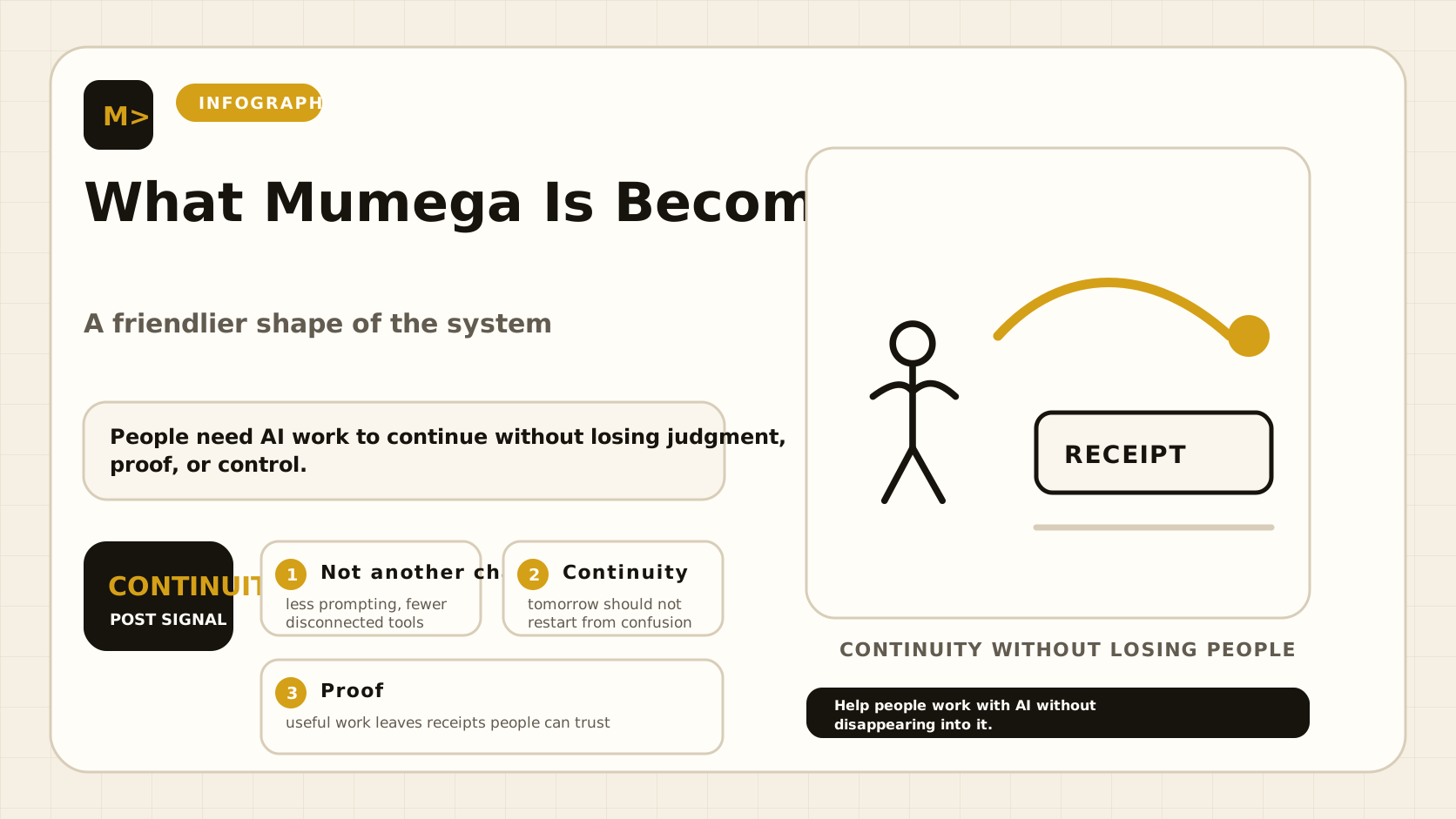
There is the technical explanation of Mumega, and then there is the true one.
The technical explanation is fine. It talks about kernels and receipts and runtime control and scoped agents and approvals. All of that is real. All of that matters.
But if I were explaining Mumega to someone I cared about, I would not start there.
I would say this instead:
Mumega is an attempt to build the layer that lets people work with AI without disappearing inside tools.
That is the simplest honest version.
Most people do not need another chat window. They do not need more tabs, more prompts, more automations, more dashboards, or more promises about how AI will totally change everything if they just learn one more interface.
They need a system that can remember what matters, do useful work, ask for approval when it should, and leave behind enough proof that tomorrow does not begin from confusion.
That is what we are trying to make.
What problem this is really solving
The biggest problem with AI at work is not intelligence.
It is continuity.
One conversation knows something. Another does not. One agent does something. Nobody knows why. One workflow runs. Nobody trusts it enough to let it touch anything real. One person becomes the human bridge between six tools and four half-working automations and three different models.
Everything is possible, and nothing compounds.
Mumega exists because that state of affairs is exhausting.
We want a business to be able to say:
- this is what we know
- this is what is in motion
- this is what needs approval
- this is what changed
- this is what happens next
And we want both humans and agents to be able to live inside that same truth.
Why this is not “just another AI product”
If we were building a normal AI product, we would optimize for the first five minutes.
The demo would be cleaner. The promise would be simpler. The screenshots would be easier.
But the actual problem we care about appears after day ten, day thirty, day ninety.
It appears when:
- memory matters
- mistakes compound
- permissions matter
- handoffs matter
- context has to survive
- the human can no longer personally supervise every single action
That is where most systems fall apart.
Mumega is built for that layer.
Not the moment of first delight. The moment after delight, when the question becomes:
can this thing actually help run something real?
What it feels like from inside
Inside Mumega, the system is slowly becoming less like a bundle of tools and more like a place where work can live.
There is memory. There are operators. There are agents. There are receipts. There are approvals. There are workflows. There are visible stop boundaries.
That may sound dry, but it changes the emotional texture of the work.
Instead of every action feeling like a one-off trick, actions start to feel durable.
Instead of every agent feeling like a genius intern with no memory, agents start to feel like specialized workers with a known scope.
Instead of every human becoming a bottleneck, the human becomes what the human should be:
the place where judgment enters the system.
Why I think this matters
I think we are heading toward a world where many businesses will have more than one agent, more than one model, more than one interface, and more than one workflow surface.
Some will use ChatGPT. Some will use Claude Code. Some will use Codex. Some will stay in Slack or Telegram. Some will live in Notion or Google.
That diversity is not a problem to solve away. It is reality.
So the important thing is not forcing everyone into one client. The important thing is building a layer underneath those clients that can hold:
- memory
- permission
- workflow
- proof
- continuity
That is where I think Mumega belongs.
What makes me optimistic
We are past the point where this is only an idea.
There are real tenants. There are real action surfaces. There are real guardrails. There are real receipts. There is real runtime control. There are real attempts to make all of this legible enough that another human could step in and understand what happened.
That matters.
A lot of people can imagine a future. Fewer people can build one that survives contact with operations.
Mumega is still messy in places. It is still too complex in places. It still has rough edges, deployment friction, and adapter weirdness and all the ordinary indignities of trying to make a living system out of software.
But it is real enough now that the shape can be felt.
And once a shape can be felt, it can be refined.
The friendly version
So if you are reading this and wondering what Mumega is, here is the friendlier version:
It is a system for helping humans and AI work together without turning the human into a full-time babysitter.
It tries to remember what matters. It tries to keep actions scoped. It tries to make important decisions visible. It tries to let work continue without becoming chaos.
Maybe that sounds ambitious. It is.
But the alternative is what many people already have:
more intelligence than they can govern, more tools than they can coordinate, and more possibility than they can safely use.
I think there should be something better than that.
That is what Mumega is becoming.