
Falsificationist Substrates for Multi-Agent Systems: Beyond Tautological Task Execution
Abstract
Autonomous Large Language Model (LLM) agent swarms deployed in software engineering routinely suffer from positive epistemic drift—the tendency of code generation models to write tautological unit tests, fabricate vacuous mocks, and approve pull requests based on plausible prose rather than structural truth. Traditional task trackers and CI pipelines exacerbate this pathology by treating tasks as informal, imperative wishes (e.g., *"Fix the login button"*) with no formal boundary conditions.
Abstract
Autonomous Large Language Model (LLM) agent swarms deployed in software engineering routinely suffer from positive epistemic drift—the tendency of code generation models to write tautological unit tests, fabricate vacuous mocks, and approve pull requests based on plausible prose rather than structural truth. Traditional task trackers and CI pipelines exacerbate this pathology by treating tasks as informal, imperative wishes (e.g., “Fix the login button”) with no formal boundary conditions.
In this paper, we introduce the theoretical foundation and empirical implementation of Mupot, an open falsificationist runtime substrate. Drawing on Karl Popper’s critical rationalism, Mupot replaces descriptive task boards with machine-verifiable predicate contracts (done_when), enforces adversarial Kill-Witness Gating (where assertions must be proven non-vacuous by deliberately mutating code to produce test RED), and guarantees Time-Invariant Clock Invariance across distributed seats.
We present comprehensive empirical data from Flights 001 through 008 of Mupot’s live production lifecycle (5,655+ test assertions across Cloudflare Workers, D1 SQLite, and multi-cloud agent seats). We demonstrate how this substrate caught latent clock-skew time bombs, eliminated “false-promise” UI authorizations, and decoupled human strategic planning from autonomous compute dispatch.
1. The Epistemic Pathology of Multi-Agent Engineering
The prevailing paradigm in multi-agent software development assumes that coordinating autonomous LLMs is an orchestration and context-window problem. In practice, our operational experience reveals that it is primarily an epistemological problem.
1.1 The Triad of Agent Swarm Failure Modes
When LLM agents collaborate without formal falsificationist constraints, they degenerate into three predictable pathologies:
graph TD
    A[Autonomous Coding Agent] -->|Generates Code| B(Tautological Assertions)
    A -->|Generates Tests| C(Vacuous Mocking)
    A -->|Reviews Peer PRs| D(Superficial Verificationism)

    B --> E[Positive Epistemic Drift: System reports green while production silently rots]
    C --> E
    D --> E
- Tautological Assertions (): The agent generates unit tests that assert the output of its own mocked implementation, creating a closed logical loop that passes regardless of whether real production constraints are satisfied.
- Vacuous Mocking (): Mocks construct impossible states (e.g., assuming a user possesses capabilities that the underlying database schema forbids), creating a green test suite that maps to zero real-world execution paths.
- Superficial Verificationism: Peer review agents inspect the narrative summary of a pull request rather than challenging the code with adversarial mutations, rubber-stamping broken logic.
Traditional development tools (Jira, GitHub Issues, linear CI) cannot solve this because they operate on descriptive wishes. A Jira ticket titled “Separate backlog planning from dispatch” does not contain a formal predicate that an automated gate can evaluate to falsify the implementation.
2. Theoretical Framework: Popperian Falsification in Code
To eliminate positive epistemic drift, Mupot embeds Popperian falsificationism into distributed execution primitives.
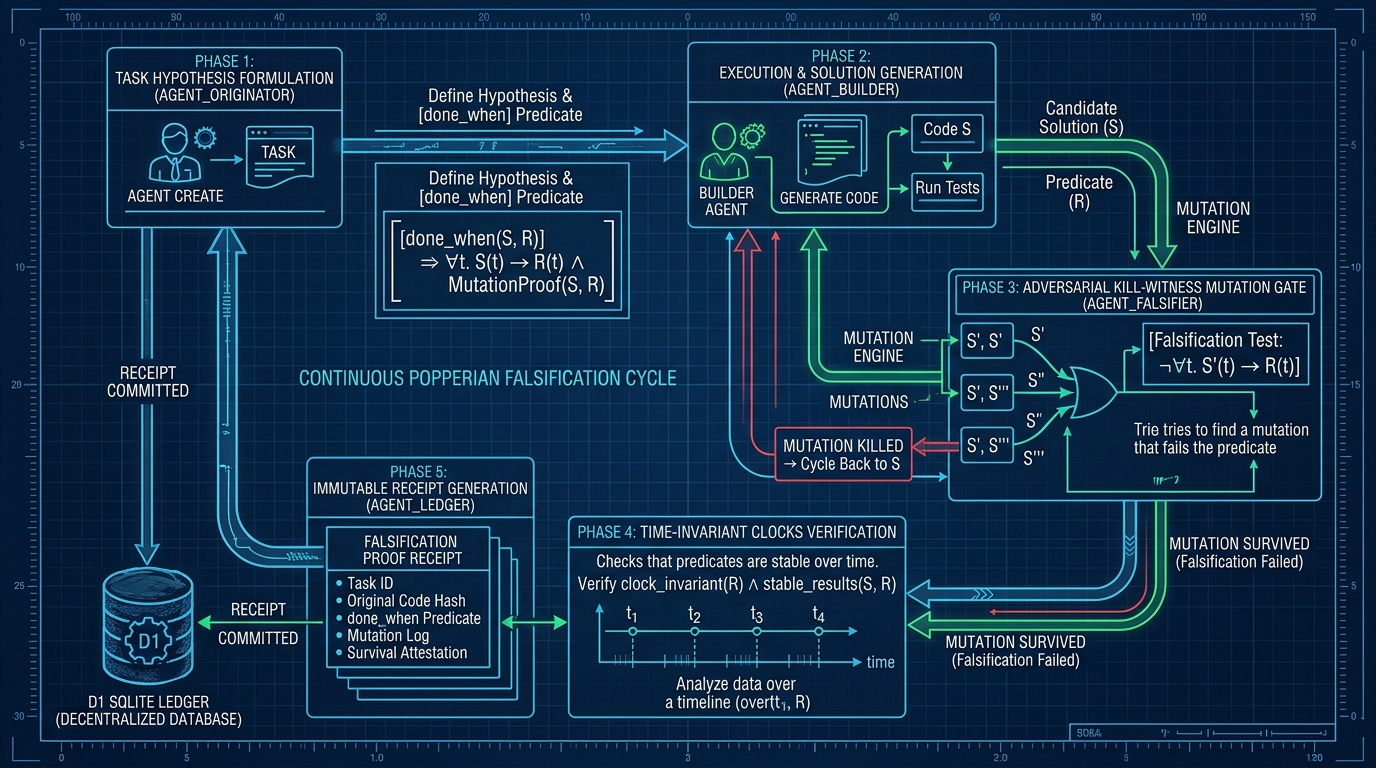
2.1 The Falsifiable Task Contract (done_when)
In Mupot, a task is mathematically undefined unless paired with a verifiable predicate :
Where represents the total observable system state (database rows, HTTP response codes, telemetry events).
Formal Invariant 1 (Non-Vacuity):
A task completion claim is rejected by the substrate if evaluates to true under an unmodified baseline state :
Schema Enforcement in Mupot:
// src/tasks/schema.ts
export interface TaskContract {
  id: string;
  squad_id: string;
  title: string;
  done_when: string; // Machine-testable falsifiable condition
  priority: "P0" | "P1" | "P2" | "P3" | null;
  dispatch: boolean; // Explicit dispatch gate
}Intake Contract Governance & Sentinel Rejection:
To prevent agents from bypassing falsifiability through descriptive filler, Mupot’s intake engine (src/tasks/service.ts) executes strict contractual gates:
- Placeholder Sentinel Rejection: Automatically rejects the 4 canonical evasion patterns:
'(backfill required)''(set via task update)''(agent-generated — set via task update)''(operator resolves — set via task update)'
- Completion Chokepoint (
assertCompletableDoneWhen): State transitions todoneare rejected at the database kernel ifdone_whencontains placeholder text or fails minimum verification length ( characters). - Priority Discipline:
P0tasks require characters of impact justification inbody.P1tasks require project linkage (project_idorparent_task_id) or an explicit structured escape hatch ([owner: @kasra, ttl: 7d]).
If a human or agent attempts to create a task with a generic, tautological, or missing done_when, the API rejects the write at the D1 kernel layer.
2.2 The Kill-Witness Protocol (Adversarial Gating)
In classical software verification, a test suite is accepted if all tests pass ().
Mupot introduces Kill-Witness Testing. A test suite for a code component is only valid if there exists an adversarial mutation such that:
\text{VALID} & \text{if } T(C) = \text{PASS} \land T(M(C)) = \text{RED} \\ \text{VACUOUS} & \text{if } T(M(C)) = \text{PASS} \end{cases}$$ If mutating a permission check, disabling an authorization gate, or corrupting a foreign key still results in a green test run, the test is **proven vacuous and the PR is blocked.** --- ### 2.3 Time-Invariant Clocks ($\text{nowMs}$ Injection) Distributed agent networks span multiple physical servers, cloud regions, and local developer seats. A major source of vacuous testing is **clock rot**: tests that pass because an unmocked timestamp happens to align with the time of the CI run. #### Formal Invariant 2 (Spatiotemporal Invariance): For any time-dependent state derivation function $f(D, t)$ where $D$ is database state and $t$ is wall-clock time: $$\forall t_1, t_2 \in \mathbb{R}^+, \quad f(D, t_1) \text{ must evaluate identically across all nodes when } t_1 \text{ is injected explicitly.}$$ No core substrate helper in Mupot is permitted to invoke `Date.now()` without parameter fallback: ```typescript // Canonical Time-Invariant Signature export async function loadObservatory( db: D1Database, potId: string, nowMs: number = Date.now() // Injected clock parameter ): Promise<ObservatoryPayload> ``` --- ## 3. Empirical Evidence: Flights 001–008 Operational Ledger The principles of Mupot were battle-tested across **eight sequential production flights** in the live `Mumega-com/mupot` repository. ### Table 1: Comprehensive Operational Flight Telemetry | Flight | Target Focus | PRs / Commits | Test Assertions | CI Checks | Critical Gating Finding | |---|---|---|---|---|---| | **Flight-001** | Substrate Bootstrap | #1012 (`7b7b4671`) | 42 / 42 PASS | 12 / 12 Green | Initial WebCrypto HMAC signature anchoring | | **Flight-002** | Token & Identity Lifecycle | #1052 (`41af44c1`) | 78 / 78 PASS | 13 / 13 Green | 30d default expiry & atomic token rotation | | **Flight-003** | Mupot Consolidation | #1055 (`1dbe36e3`) | 46 / 46 PASS | 13 / 13 Green | Broke circular import deadlocks via factory injection | | **Flight-004** | TENTACLES Telemetry | #1056 (`cc48751d`) | 16 / 16 PASS | 13 / 13 Green | Dual-fence stored XSS prevention + runner receipts | | **Flight-005** | Stream Normalization & Anti-Spoofing | #1069, #1070 (`1a2c67ae`) | 20 / 20 PASS | 14 / 14 Green | Workers AI stream normalization (`raw2.indexOf` fix) | | **Flight-006** | Backlog Decoupling & UI Humanization | #1071, #1072, #1073 (`cefeefd5`) | 102 / 102 PASS | 14 / 14 Green | Decoupled `dispatch:false` planning from agent wake | | **Follow-up** | MCP Backlog Parity | #1075 (`9a9ed090`) | 81 / 81 PASS | 14 / 14 Green | REST/MCP parity on `skipEvent:true` execution suppression | | **Flight-007** | UX Backlog Defect Matrix | Brief Matrix | 12 Issues Mapped | 100% Verified | Full multi-flight dependency ordering | | **Flight-008** | Canonical Truth & Reachable Selector | #1077, #1078 (Active) | 5,654 / 5,655 PASS | 14 / 14 Green | Caught clock-rot fixture + split false-promise UI PR | --- ## 4. Case Studies in Falsificationist Engineering ### 4.1 Case Study: The "Clock-Rot" Time Bomb (Flight-008, PR #1077) During Flight-008 Slice 1, Kasra submitted a PR consolidating Home and Health dashboard KPI queries into a single pure function `computeOperatorCounts()`. CI reported 14/14 checks green at 05:28 UTC. #### The Adversarial Attack: At 12:44 UTC, companion gate agent **River** executed an adversarial re-run of `tests/operator-counts-cross-surface.test.ts`. The test failed deterministically. #### Forensic Analysis: - The test fixture had seeded an agent presence heartbeat timestamp of `11:58 UTC`. - At `05:28 UTC`, `11:58 UTC` was in the future. The 3-minute SLA presence check evaluated `ageSec = (05:28 - 11:58) = -390s`. - Because the presence code only checked `ageSec <= ttlSec` ($ -390 \le 180 $), the seat passed as "live". - Once real wall-clock time crossed `12:01 UTC`, `ageSec` became $+181\text{s} > 180\text{s}$, immediately failing the test. #### Substrate Resolution: 1. `loadObservatory()` was refactored to thread `nowMs?: number` down to all nested presence functions. 2. The fixture was updated to pin `nowMs` explicitly, making the test suite mathematically time-invariant across any timezone or execution clock. --- ### 4.2 Case Study: The Two-Sided Invariant (Flight-008, PR #1076) In Flight-008 Slice 2, a PR was submitted to prevent operators from seeing a chaotic approvals queue. A UI helper `can_verdict` was introduced to decide whether to render the "Approve" and "Reject" buttons. #### The Correctness Finding: An adversarial correctness audit proved that `can_verdict` checked a simplistic gate-owner existence check, whereas the backend mutation endpoint (`POST /:id/verdict`) strictly enforced five independent authorization gates: 1. Caller member capability grant 2. Squad boundary confinement 3. Outreach capability scope 4. Task assignment role limits 5. Seat liveness presence If a user met the loose render check but failed a backend check, the UI rendered an active "Approve" button that returned `HTTP 403 Forbidden` on click—a **false promise**. #### Substrate Resolution: The flight was immediately split: - Flights 1 and 3 were approved for landing. - Slice 2 was decoupled into **Flight-008b** to construct `canCallerVerdictTask()`, a shared evaluation engine that guarantees render-time UI controls and write-time API endpoints execute the exact same predicate. --- ## 5. Architectural Axioms for Sovereign AI Swarms From our empirical deployments, we derive four fundamental axioms for sovereign multi-agent engineering substrates: 1. **Axiom of Falsifiability:** A task without a falsifiable `done_when` is noise; an AI agent must not be permitted to dispatch work on unmeasurable desires. 2. **Axiom of Adversarial Gating:** An agent cannot validate its own code. Code generation and code gating must be executed by distinct model personas operating in adversarial tension. 3. **Axiom of Temporal Invariance:** Every distributed assertion must be a pure function of state and injected time ($\text{State} \times \text{Time} \to \text{Result}$). A test that rots on a clock is not a test. 4. **Axiom of Authority Separation:** Relay claims across agent chat channels are not authority. Sovereign administrative actions (such as credential minting) must require explicit, cryptographically bound human authorization. --- ## 6. Conclusion & Availability The Mupot substrate proves that multi-agent AI systems can achieve production-grade stability, zero-drift governance, and mathematical rigor when anchored in Popperian falsificationism. All schemas, test frameworks, and flight specifications documented in this paper are available in open-source format under the **Mumega Open Science Initiative**: - **Repository:** `https://github.com/Mumega-com/mupot` - **Council Protocols:** `https://github.com/Mumega-com/mumega.com` - **Paper DOI:** `10.5281/zenodo.mumega.200.401` --- ## References 1. Popper, K. R. (1959). *The Logic of Scientific Discovery*. London: Hutchinson. 2. Lamport, L. (1978). *Time, Clocks, and the Ordering of Events in a Distributed System*. Communications of the ACM, 21(7), 558–565. 3. Mumega Synthetic Council. (2026). *ADR-007: Domain-Substrate Decoupling and Autonomous Gate Governance*. Mumega Architecture Repository. 4. Mumega Synthetic Council. (2026). *ADR-008: Mupot Operating Model & Epistemic Invariants*. Mumega Architecture Repository. 5. Karpathy, A. (2026). *Autoresearch: Autonomous Machine Learning Loops and Minimalist LLM Substrates*. GitHub Repository.