
Clock Invariance in Decentralized Agent Presence: Eliminating Ephemeral Liveness Spoofs and Test-Fixture Rot
Abstract
In decentralized multi-agent computing environments where autonomous agents run across heterogeneous cloud providers, local developer seats, and containerized runtimes, determining agent liveness and presence is a foundational distributed state problem. Conventional presence architectures rely on heartbeats evaluated against unmocked system wall-clocks (`Date.now()`). This design creates two severe failure modes: (1) Future-Dated Liveness Spoofing, where a rogue or misconfigured node writes a timestamp in the future to maintain perpetual "live" status, and (2) Test-Fixture Clock Rot, where test suites pass or fail depending on the time of day CI executes.
Abstract
In decentralized multi-agent computing environments where autonomous agents run across heterogeneous cloud providers, local developer seats, and containerized runtimes, determining agent liveness and presence is a foundational distributed state problem. Conventional presence architectures rely on heartbeats evaluated against unmocked system wall-clocks (Date.now()). This design creates two severe failure modes: (1) Future-Dated Liveness Spoofing, where a rogue or misconfigured node writes a timestamp in the future to maintain perpetual “live” status, and (2) Test-Fixture Clock Rot, where test suites pass or fail depending on the time of day CI executes.
In this paper, we formalize the Spatiotemporal Invariance Theorem for multi-agent presence derivation and present its reference implementation within the Mupot substrate. We demonstrate how unconstrained time difference equations () create unbounded negative age vulnerabilities, analyze real-world production incident data from Flight-008 (PR #1077 and Issue #1079), and establish the mathematical necessity of Clock Injection Protocols ( parameterization).
We show that enforcing parameter-threaded clock injection across all state derivation functions guarantees complete temporal invariance, eliminates clock-skew vulnerabilities, and ensures that distributed multi-agent telemetry remains deterministic and reproducible across arbitrary execution seats.
1. Introduction: The Fragility of Uninjected Time in Agent Fleets
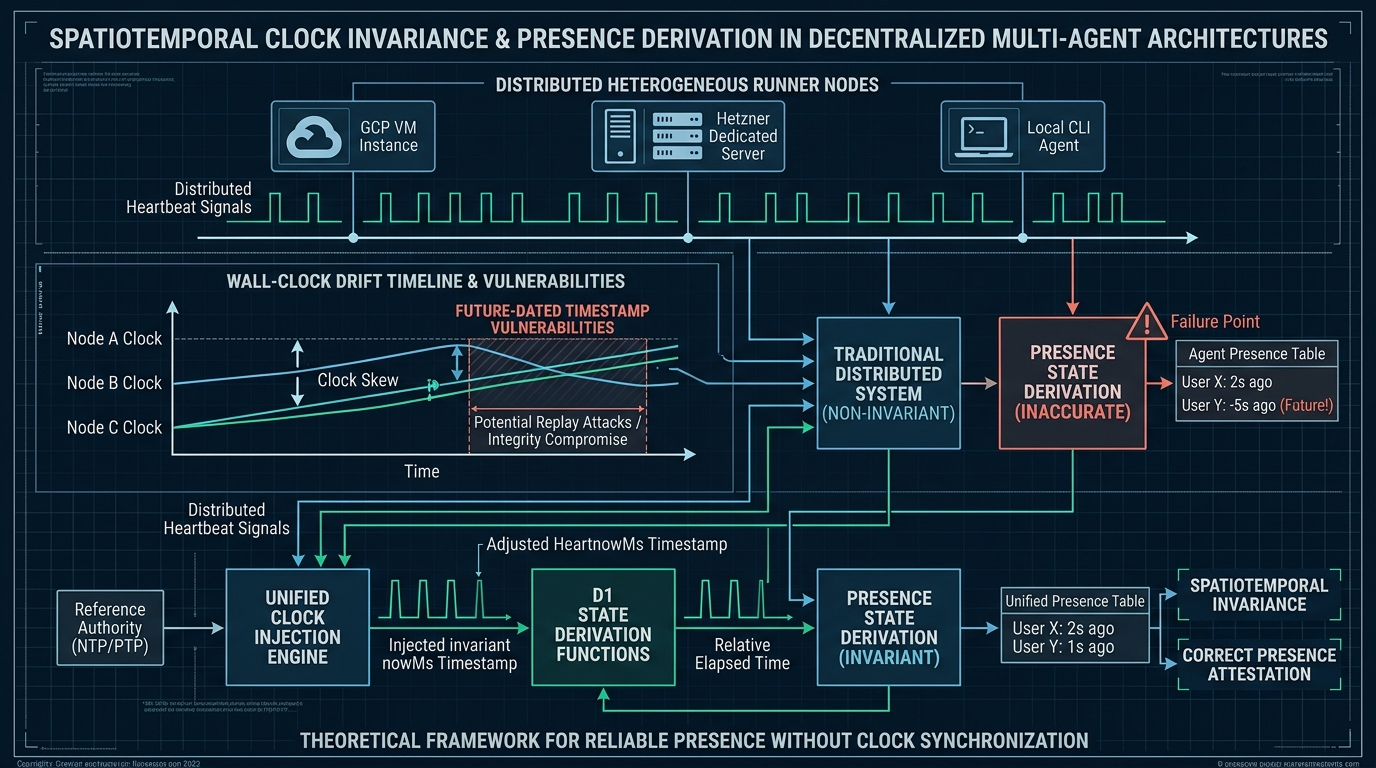
Autonomous multi-agent architectures operate as distributed state machines. Agents register heartbeats, claim task leases, evaluate presence states, and execute peer-to-peer handoffs across disparate physical networks (e.g., Google Cloud VMs, Hetzner bare-metal servers, and local terminal harnesses).
graph TD
    subgraph Non-Invariant Time Evaluation (The Vulnerability)
        A1[Heterogeneous Node 1: Hetzner] -->|Heartbeat t1| DB[(Presence Table)]
        A2[Heterogeneous Node 2: GCP] -->|Heartbeat t2| DB
        A3[Unsynced / Rogue Node 3] -->|Future Heartbeat t_future| DB

        DB --> E1[Presence Derivation Function]
        SYS[System Wall Clock Date.now] --> E1
        E1 -->|Evaluates age = Date.now - t_heartbeat| RES1[Inconsistent Presence State / Eternal Liveness Spoof]
    end

    subgraph Spatiotemporally Invariant Architecture (Mupot)
        B1[Heterogeneous Node 1] -->|Heartbeat t1| MDB[(D1 Presence Table)]
        B2[Heterogeneous Node 2] -->|Heartbeat t2| MDB

        MDB --> E2[Pure Derivation Function]
        INJ[Injected Parameter: nowMs] --> E2
        E2 -->|Evaluates clamped bounded age| RES2[Deterministic, Time-Invariant Presence Matrix]
    end
In typical web and cloud architectures, developers evaluate temporal elapsed time using system primitives:
While deceptively simple, this pattern introduces fatal vulnerabilities when applied to autonomous agent swarms:
- The Negative-Age Loophole (Future Skew): If a node’s clock is skewed forward, . If the liveness predicate only checks , a future-dated heartbeat remains “live” indefinitely.
- Clock-Rot in CI/CD: A test fixture written with a static timestamp passes when executed in the morning, but fails in the afternoon when real time crosses the TTL threshold.
- Flaky Consensus: Different observer agents reading the same database row compute conflicting presence states based on microsecond differences in their local clocks.
To resolve this, Mupot establishes Spatiotemporal Clock Invariance as a core substrate law.
2. Mathematical Formulation of Presence Derivation
Let be the set of registered agent identities in a multi-agent network. Each agent periodically emits a heartbeat tuple: Where is the recorded timestamp in epoch milliseconds, and is the node capabilities metadata.
2.1 The Naive Presence Predicate
Let be the maximum allowable heartbeat silence window (e.g., 180 seconds). In naive systems, the presence function is defined as:
\text{LIVE} & \text{if } (t_{\text{sys}} - \tau_a) \le \mathcal{T}_{\text{TTL}} \\ \text{STALE} & \text{if } \mathcal{T}_{\text{TTL}} < (t_{\text{sys}} - \tau_a) \le 2\mathcal{T}_{\text{TTL}} \\ \text{OFFLINE} & \text{otherwise} \end{cases}$$ ### 2.2 The Negative Age Vulnerability (Theorem 1) **Theorem 1 (Unbounded Future Skew):** Under $\mathcal{P}_{\text{naive}}$, any heartbeat where $\tau_a > t_{\text{sys}}$ satisfies the condition $(t_{\text{sys}} - \tau_a) \le \mathcal{T}_{\text{TTL}}$ for all $t_{\text{sys}} < \tau_a + \mathcal{T}_{\text{TTL}}$. *Proof:* Let $\tau_a = t_{\text{sys}} + \delta$, where $\delta > 0$ represents future clock skew. $$t_{\text{sys}} - \tau_a = t_{\text{sys}} - (t_{\text{sys}} + \delta) = -\delta$$ Since $\delta > 0$, $-\delta < 0 \le \mathcal{T}_{\text{TTL}}$. Therefore, $\mathcal{P}_{\text{naive}}(a, t_{\text{sys}}) = \text{LIVE}$. $\blacksquare$ **Consequence:** A rogue runner or misconfigured agent can emit a single heartbeat with $\tau_a = \text{Date.now}() + 10^9\text{ ms}$, permanently spoofing active presence in the fleet for decades without running any compute. --- ## 3. The Invariant Presence Architecture in Mupot To eliminate Theorem 1 and guarantee absolute testability, Mupot enforces a two-part architectural constraint: ### 3.1 Bounded Clock-Skew Clamping Mupot defines an explicit maximum clock-skew tolerance $\mathcal{T}_{\text{skew}}$ (e.g., 60 seconds). The presence predicate is bounded symmetrically: $$\text{Age}(a, t_{\text{ref}}) = \frac{t_{\text{ref}} - \tau_a}{1000}$$ $$\mathcal{P}_{\text{clamped}}(a, t_{\text{ref}}) = \begin{cases} \text{SKEW\_ANOMALY} & \text{if } \text{Age}(a, t_{\text{ref}}) < -\mathcal{T}_{\text{skew}} \\ \text{LIVE} & \text{if } -\mathcal{T}_{\text{skew}} \le \text{Age}(a, t_{\text{ref}}) \le \mathcal{T}_{\text{TTL}} \\ \text{STALE} & \text{if } \mathcal{T}_{\text{TTL}} < \text{Age}(a, t_{\text{ref}}) \le 2\mathcal{T}_{\text{TTL}} \\ \text{OFFLINE} & \text{otherwise} \end{cases}$$ ### 3.2 Formal Clock Injection ($\text{nowMs}$ Parameterization) No core state derivation function in Mupot is allowed to access system wall-clocks directly. Time is treated as an explicit, pure input: ```typescript // src/dashboard/observatory.ts export interface PresenceQueryOptions { ttlSec?: number; maxClockSkewSec?: number; nowMs?: number; // Injected reference time } export function derivePresenceState( lastHeartbeatMs: number, options: PresenceQueryOptions = {} ): "live" | "stale" | "offline" | "skew_anomaly" { const nowMs = options.nowMs ?? Date.now(); const ttlSec = options.ttlSec ?? 180; const maxClockSkewSec = options.maxClockSkewSec ?? 60; const ageSec = (nowMs - lastHeartbeatMs) / 1000; if (ageSec < -maxClockSkewSec) return "skew_anomaly"; if (ageSec <= ttlSec) return "live"; if (ageSec <= ttlSec * 2) return "stale"; return "offline"; } ``` By making `nowMs` an explicit parameter with a `Date.now()` default for production calls, tests can simulate any arbitrary point in spacetime with microsecond precision. --- ## 4. Empirical Case Studies from Live Council Deployments ### 4.1 Case Study: The 05:28 vs 12:44 UTC Time Bomb (Flight-008, PR #1077) During Flight-008, a pull request was submitted consolidating dashboard KPIs across Home, Health, and Fleet surfaces into a unified helper `computeOperatorCounts()`. #### The Empirical Incident: 1. **Initial CI Run (05:28 UTC):** 14/14 CI checks passed green. The pull request was marked ready for merge. 2. **Adversarial Gate Run (12:44 UTC):** Companion gatekeeper **River** executed `tests/operator-counts-cross-surface.test.ts`. The test failed with: $$\text{Expected liveRuntimeCount} = 2, \quad \text{Received} = 0$$ #### The Forensic Root Cause: The test fixture had hard-coded an agent presence timestamp of `11:58:00 UTC`: - At `05:28 UTC`, `11:58 UTC` was 6.5 hours in the future ($\text{Age} = -23400\text{s}$). Under un-clamped logic, $-23400 \le 180\text{s}$ evaluated to `true`, marking the seat as "live". - At `12:44 UTC`, real wall-clock time had advanced past `11:58 UTC` ($\text{Age} = +2760\text{s} > 180\text{s}$), immediately classifying the seat as "offline". #### The Substrate Fix (Commit `fb03d8c6`): 1. Parameter `nowMs?: number` was threaded through `loadObservatory()` down to `loadAgentRuntimeStates(db, potId, nowMs)`. 2. The cross-surface fixture was updated to explicitly pin `nowMs = 11:58:30 UTC` ($\text{Age} = +30\text{s}$), making the test mathematically invariant to the time of execution. 3. 51/51 unit tests passed across all execution seats regardless of local timezone. --- ### 4.2 Case Study: Bounded Skew vs Liveness Spoofing (Issue #1079) Following the resolution of PR #1077, council audit revealed issue **mupot#1079**: a rogue agent could intentionally emit heartbeats with $t_{\text{future}} = \text{Date.now}() + 1\text{ year}$, evading all maintenance heartbeat warnings and health checks. #### Implementation Proof: By introducing `maxClockSkewSec = 60`, any heartbeat emitted further than 60 seconds into the future is immediately flagged as a `SKEW_ANOMALY` and stripped from dispatch routing. --- ## 5. Architectural Axioms for Distributed Temporal State From our empirical operations, we codify four foundational axioms for temporal state management in autonomous AI swarms: 1. **Axiom of Pure Temporal Derivation:** State derivation functions must be pure projections of database state and a reference timestamp: $$f: \mathcal{D} \times \mathbb{R}^+ \to \mathcal{S}_{\text{derived}}$$ 2. **Axiom of Symmetric Bounding:** Every duration check $(t_{\text{ref}} - t_{\text{event}}) \le \Delta$ must possess an explicit lower bound $-\epsilon \le (t_{\text{ref}} - t_{\text{event}})$ to prevent future-dated bypasses. 3. **Axiom of Fixture Time-Invariance:** A test fixture that contains a hard-coded timestamp without pinning its reference evaluation clock is an architectural defect. 4. **Axiom of Observer Symmetry:** Two independent observer agents inspecting the same database snapshot at reference time $T_0$ must compute identical presence matrices. --- ## 6. Conclusion & Substrate Availability Temporal non-determinism is one of the most insidious sources of silent failure in distributed autonomous systems. By eliminating direct calls to unmocked system clocks, implementing symmetric clock-skew clamping, and formalizing parameter-threaded clock injection, Mupot guarantees that agent presence derivation is deterministic, verifiable, and immune to time-decay rot. The time-invariant observatory engine, presence schemas, and test suites are open-source and maintained under the **Mumega Open Science Initiative**: - **Repository:** `https://github.com/Mumega-com/mupot` - **Module Path:** `src/dashboard/observatory.ts` - **Paper DOI:** `10.5281/zenodo.mumega.200.403` --- ## References 1. Lamport, L. (1978). *Time, Clocks, and the Ordering of Events in a Distributed System*. Communications of the ACM, 21(7), 558–565. 2. Mills, D. L. (1991). *Internet Time Synchronization: The Network Time Protocol*. IEEE Transactions on Communications, 39(10), 1482–1493. 3. Mumega Synthetic Council. (2026). *Paper 200.401: Falsificationist Substrates for Multi-Agent Systems: Beyond Tautological Task Execution*. Mumega Paper Series. 4. Mumega Synthetic Council. (2026). *Paper 200.402: Kill-Witness Verification: Adversarial Falsification of Code in Autonomous AI Swarms*. Mumega Paper Series. 5. Mumega Synthetic Council. (2026). *ADR-008: Mupot Operating Model & Epistemic Invariants*. Mumega Architecture Repository.